
Know where every device is. Always.
Orthopedic implants, spine trays, and trauma sets live in consignment closets, rep trunks, hospital shelves, and warehouse bins. Deviceflow gives you real-time inventory visibility across all of it — without barcode guns, new apps, or quarterly physical counts.
- Real-time consignment tracking
- Photo-based audits — no barcode guns
- Automated par-level replenishment
- Full lot and expiration tracking
“I asked how many instruments we have to make complete trades. They said, 'We can send you a spreadsheet of what we have — because we don't know.'”
Consignment, trunk stock, loaners — tracked automatically
Deviceflow tracks every product movement as it happens across every inventory model. Consignment at hospitals, trunk stock with reps, loaner kits in transit — one system replaces the spreadsheets, phone calls, and quarterly counts.
Location-Level Visibility
See every device across every location — warehouse shelves, consignment closets, rep trunks, loaner sets in transit. One view replaces the spreadsheets, emails, and phone calls your team uses to figure out where things are. When a surgeon asks for a specific size, you know exactly where it is in seconds.
- Real-time view across all locations
- Warehouse, consignment, trunk, and loaner tracking
- Instant product search by size, lot, or location
- Replace spreadsheets with a single dashboard
Spreadsheets vs. Deviceflow
The way most teams track inventory was designed for a world with fewer SKUs, fewer locations, and fewer regulations.
Fewer shipments. No stockouts.
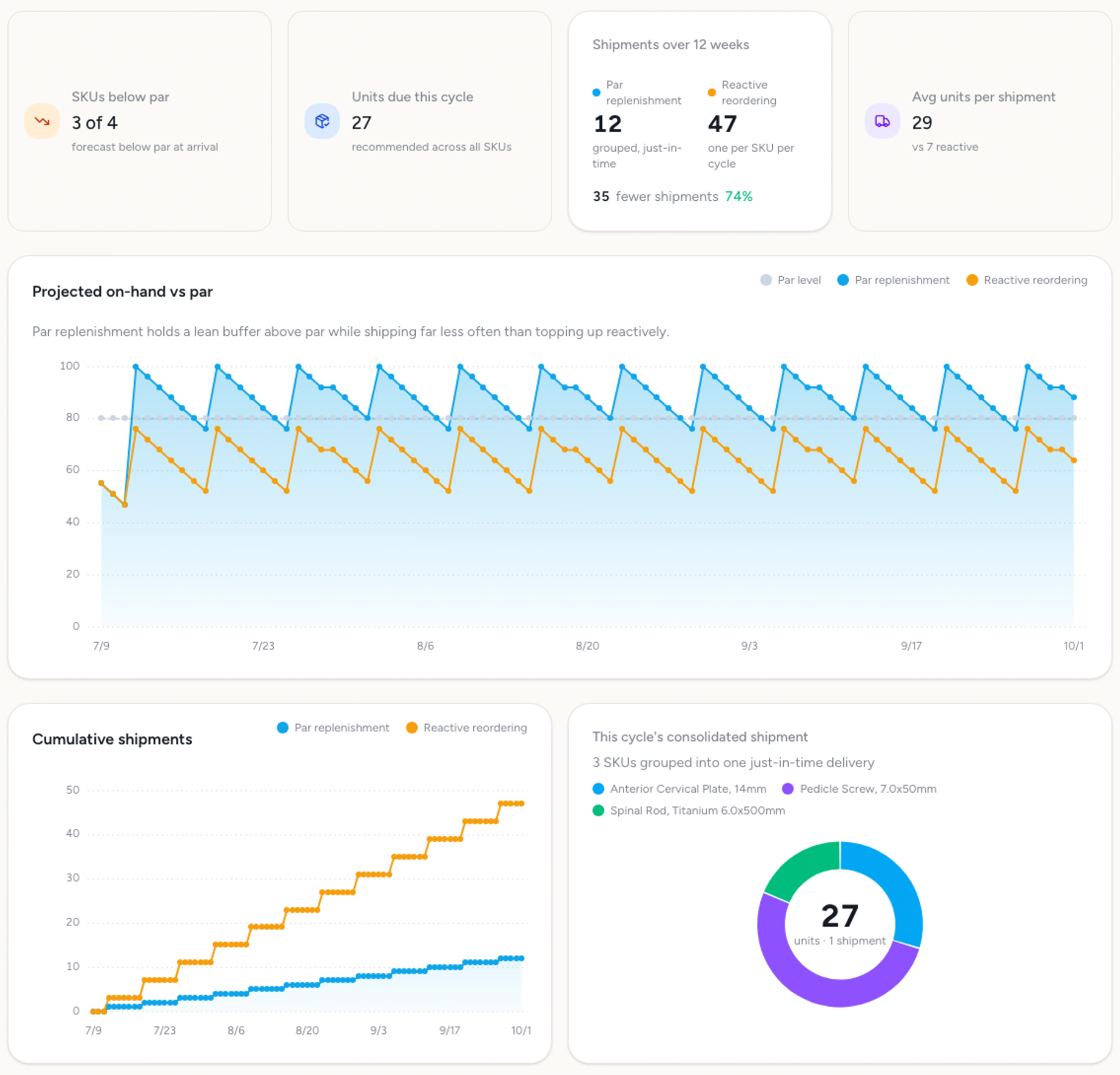
Knowing when to replenish is only half the problem — most teams still ship a box after every case. Deviceflow forecasts demand per account, applies your par rules, and consolidates replenishments into fewer, planned shipments. Product availability goes up while freight spend comes down.
Reactive reordering
A shipment after every case. Freight grows one-for-one with case volume, and stockouts still surprise you at case prep.
Par-level replenishment
Demand forecasts and per-account par rules consolidate shipments. In our simulation, shipment count fell by more than half — with inventory above par the entire time.
How it works
Deviceflow tracks every product movement as it happens — from warehouse to consignment to trunk to surgery to invoice. No manual updates. No reconciliation scrambles.
See every device across every location — warehouse shelves, consignment closets, rep trunks, loaner sets in transit. One view replaces the spreadsheets, emails, and phone calls your team uses to figure out where things are.
Location tracking tells you where a tray is. It doesn't tell you what's inside it. Deviceflow tracks inventory at the set and kit level — what each tray holds and which sets every rep is carrying — and enforces the min/max par you set, so reps stop building their own kits and reorders match real usage.
Reps photograph trays and shelves. Deviceflow identifies products, matches to expected inventory, and flags discrepancies. A quarterly audit that used to take 5 months now takes 4 weeks.
When a case consumes inventory, replenishment triggers automatically based on par levels you set per location. No more "we ran out of the 32mm heads at St. Mary's" surprises.
Every product movement captures lot numbers and expiration dates. When a recall hits or a lot expires, you know exactly where every affected unit is — in seconds, not days.
When a rep needs a set that's at another location, Deviceflow coordinates the transfer — notifying the source, tracking shipment, and updating both locations. Loaner returns get tracked the same way.
Compare expected vs. actual inventory at any location, any time. Deviceflow surfaces discrepancies the moment they happen — not three months later during a physical count.
What does your inventory management actually cost?
Every misplaced tray, expired product, and manual count costs time and money. Adjust the sliders to see what that adds up to.
The formula: 300 cases × 4 touches × $25 per touch × 12 months = $360,000/year in processing labor.
20-min call. We'll use your real numbers, not these defaults.
Human oversight by design
Deviceflow automates the repetitive coordination work your team shouldn't be doing manually. When a decision matters — recall execution, compliance submissions, billing exceptions — the system routes it to your team for approval. Every automated action has a complete audit trail. No irreversible decisions happen without a human in the loop.
Validated for QMSR audits
Deviceflow ships with a full GAMP5 Category 4 validation package — URS, IQ/OQ/PQ protocols, requirements traceability matrix, supplier qualification, Part 11 access provisions, and tamper-evident audit-trail exports. Walk into your next QMSR inspection with the supplier documentation already prepared. Your quality team stays focused on the device, not on validating your ops stack. Read the validation burden brief →
Keep going
Read deeper or find your role
Dig into the practitioner-written background — and see how field inventory lands inside each function.
Inventory & operations reading
For your role
Most companies we talk to discover 10-15% of their field inventory is untracked. Let us show you a better way.
The Space Between
What happens between what your field team sends and what your systems need — and what your team can stop doing manually.