
The POs you're owed are sitting in reps' inboxes. Deviceflow goes and gets them.
The problem was never matching POs — it's collecting them. Every week, someone runs a report of bill-onlys missing POs and chases reps by email. Deviceflow finds the gaps, chases what's missing, matches on arrival, and turns it into an invoice — so cash stops waiting on a spreadsheet.
Revenue you can see, before the GL does
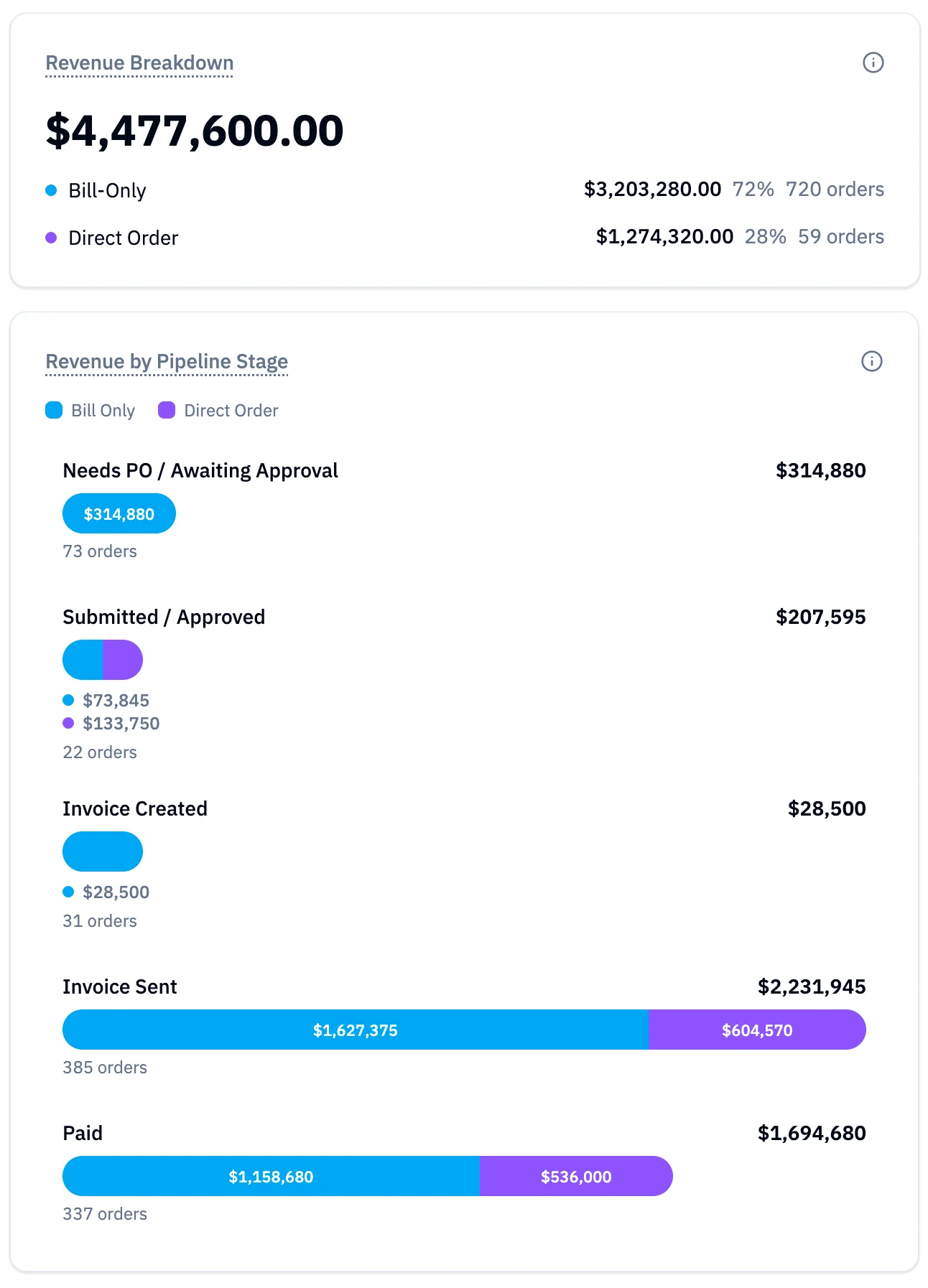
Your general ledger sees revenue once the PO is processed — sometimes weeks after the case. Deviceflow sees it as soon as it happens. Bill-only submitted, PO matched, invoice sent, paid — every dollar tracked by stage, in real time.
Before Deviceflow
Revenue is invisible until the PO clears your ERP — days or weeks behind reality. DSO is a lagging indicator you discover at month-end.
After Deviceflow
Revenue moves through every pipeline stage on a live dashboard. You see what's stuck before it hits your GL — and act on it in days, not weeks.
The Problem
Your billing team is the bottleneck between surgery and revenue. POs arrive as PDFs buried in email. Billers manually read every line, match to cases, validate pricing against contracts, and chase reps when things don't match. Every handoff is a delay. Every delay is cash sitting on the table.
Your AR Is Waiting on POs That Never Arrived
The bottleneck was never matching POs — it’s collecting them. Every week, someone runs a report of bill-onlys missing purchase orders and emails the list to reps and AVPs, who then figure out which distributor each one belongs to and chase it down individually. That chain costs 5–8 hours a week, and until the PO shows up, the cash sits.
What teams tell us“One of our major problems is PO collection, not PO matching. If that PO does not get into the email, then none of us can do anything until that.”
Deviceflow runs the missing-PO report for you, routes each gap to the rep or AVP who owns it, and chases it to collection automatically — so cash stops waiting on a weekly spreadsheet.
Billing Cycles Measured in Weeks, Not Days
POs arrive as PDFs. Billers manually extract data, match to cases, validate SKUs and pricing, and investigate every mismatch. A single invoice can touch 4–5 people before it’s sent. For a company doing $10M in annual revenue, shaving 5 days off the invoicing cycle can free up hundreds of thousands in working capital.
What teams tell us“We're still double-checking everything. Then you've got to reopen the case when the purchase order finally comes in. We're all touching this stuff.”
Deviceflow reads the PO, matches it to the case, validates the pricing, and generates the invoice in one pass — so a bill-only goes out the day the case closes instead of touching five hands first.
Revenue Leakage: Missed Cases, Not Just Mispriced Ones
Mispriced line items and incorrect quantities are the leakage you can see. But the bigger problem is cases that never get invoiced at all — a rep emails the bill-only to the wrong address, forgets to submit after a late case, or the charge sheet gets lost in a shared inbox. That’s real revenue that was earned but never billed. By the time you see it in reconciliation, the write-off is already booked.
What teams tell us“We had all these purchase orders from hospitals in Q4, and no one was keeping track. We got down to it — $60,000 sitting out there at hospitals that we never collected.”
Deviceflow tracks every case from field submission through billing and flags any that closed without an invoice in your window — so earned revenue gets billed instead of written off.
Headcount Scales Linearly with Volume
Double your case volume? Double your billing team. Each touch costs $25–50 in labor. A single bill-only passing through 3–4 hands costs $100–200 before it becomes cash. At 750 cases a month, that’s a half-million dollars in annual processing cost — and every new hire just adds another person to the same manual process.
What teams tell us“These people are making six figures, and they're spending the vast majority of their time executing transactions.”
Deviceflow handles the reading, matching, and validating automatically and surfaces only true exceptions — so the team absorbs more volume without another back-office hire.
You Find Out Where Revenue Is Stuck After It’s Already Late
No real-time view of where cases are in the billing pipeline. DSO is a lagging indicator — by the time you see the number, the damage is done. You can’t forecast what you can’t see.
What teams tell us“Our AR cycle is really long. We're sitting on cash for weeks while we wait for charge sheets to be properly processed and submitted to billing.”
Deviceflow shows every case live by billing stage — pending charge sheet, awaiting PO, in reconciliation, invoiced — so DSO is a number you act on early, not discover at month-end.
Contract Pricing Is a Moving Target That Nobody Hits
A single SKU can have different prices at different hospitals, under different GPO agreements, with different effective dates. Reps fill in prices from memory or outdated sheets. Your billing team audits every charge sheet, looks up the correct contract price, and corrects the submission before invoicing. That’s credit/rebill cycles, strained distributor relationships, and hours of work that shouldn’t exist.
What teams tell us“We have 303 unique customers but 300 different pricing models.”
Deviceflow validates every line against that account’s contract — GPO tiers and effective dates included — before the invoice is created, so the right price lands the first time.
When Pricing Is Wrong, Your Team Bills It Twice
A price that doesn’t match the contract means a refund and a rebill — double the work, slower cash, and a credit memo to clean up.
What teams tell us“Pricing issues are extremely expensive because you have to rebill. You have to refund and bill again.”
Deviceflow checks every charge sheet against contract pricing before it becomes an invoice, so the bill goes out right the first time — no refund, no rebill.
How Deviceflow Solves It
| Capability | What It Means for You |
|---|---|
| Automated Reconciliation | AI detects when PO and bill-only differ on price, quantity, SKU, or lot. Surfaces only true exceptions for human review — instead of forcing billers to check every line of every order. |
| End-to-End Invoice Pipeline | Case entry → PO match → invoice generation → ERP sync. Minimizes manual steps and copy-paste errors across your entire billing workflow. Your ERP creates invoices — we fill the gap before that. |
| Exception Management Queue | A prioritized inbox of “issues to resolve” with full context: what’s wrong, who to contact, and a suggested resolution. No more hunting through email threads. |
| Cash & Revenue Metrics | Real-time visibility into unbilled cases, aging POs, and reconciliation status. Predictable timelines from case to invoice. Forecasting based on data, not guesswork. |
| Complete Digital Audit Trail | Every case linked to its PO, reconciliation, invoice, and payment — in one place. No more reconstructing the paper trail from email chains and spreadsheets when auditors come knocking. |
Automated Reconciliation
AI detects when PO and bill-only differ on price, quantity, SKU, or lot. Surfaces only true exceptions for human review — instead of forcing billers to check every line of every order.
End-to-End Invoice Pipeline
Case entry → PO match → invoice generation → ERP sync. Minimizes manual steps and copy-paste errors across your entire billing workflow. Your ERP creates invoices — we fill the gap before that.
Exception Management Queue
A prioritized inbox of “issues to resolve” with full context: what’s wrong, who to contact, and a suggested resolution. No more hunting through email threads.
Cash & Revenue Metrics
Real-time visibility into unbilled cases, aging POs, and reconciliation status. Predictable timelines from case to invoice. Forecasting based on data, not guesswork.
Complete Digital Audit Trail
Every case linked to its PO, reconciliation, invoice, and payment — in one place. No more reconstructing the paper trail from email chains and spreadsheets when auditors come knocking.
Go deeper on what matters to you
Billing Automation
PO matching, reconciliation, and invoice generation — from weeks to same-day.
Field Operations
Faster case close means faster billing trigger. The revenue clock starts here.
Inventory Management
Accurate inventory = accurate invoices. No more write-offs from mismatched counts.
What Finance Leaders Ask Us
We'll quantify it with you. Book a 30-minute walkthrough and we'll map your actual cost-per-touch.